Spot a parakeet in aid of research study
The Rose-ringed Parakeet Psittacula krameri is native to southern Asia and sub-Saharan Africa and is the world’s most invasive parrot species.
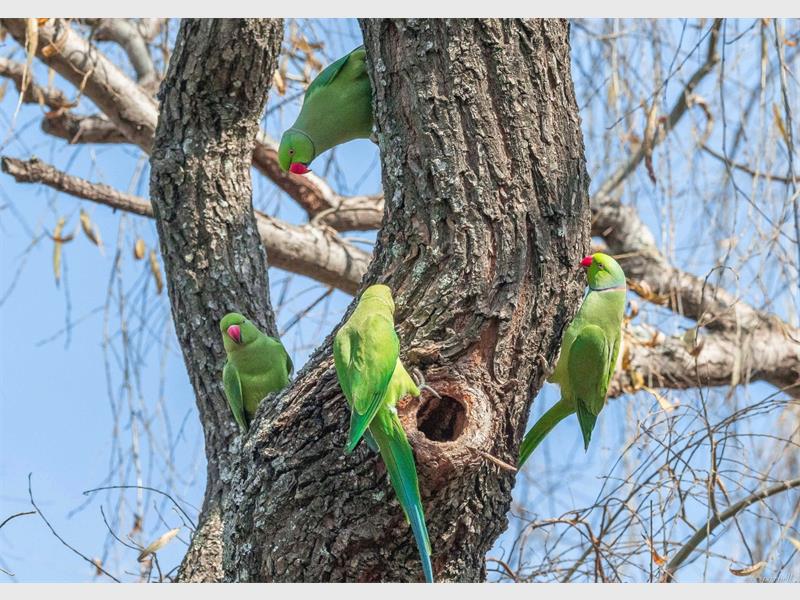

According to Elize Fourie, of the School of Animal, Plant and Environmental Sciences at the University of the Witwatersrand, in South Africa, where it became established in the 1970s, the parakeet is classified as a Category 2 invasive species in the National Environmental Management Biodiversity Act.
“Well-established, actively breeding but fragmented populations occur in Gauteng and KwaZulu-Natal. Their occurrence and spread are strongly linked to human density, urban settlements and parks,” said Fourie.
“However, the impact of the species on local biodiversity (native bird species) and the environment are not known and, therefore, quantifiable scientific data must be obtained.
“Researchers from the University of the Witwatersrand have launched the Rose-ringed Parakeet Project to locate roosting sites and to investigate the size and distribution of the Rose-ringed Parakeet population in South Africa.
“This will be complemented by parallel studies (in association with European researchers and ParrotNet) on the behaviour of these birds in Gauteng.
“This will improve our understanding of the ecology and behaviour of the species in South African urban environments and ensure that informed decisions are made by policy makers regarding the status and management of this parrot.”
If you spot these birds anywhere (free-flying) in South Africa or you know of a roosting/breeding site in your neighbourhood, please submit your data as follows:
* Using Google forms. Follow this link to the data form, fill it in, and submit. You may submit more than one form. Please fill in all required fields as completely as possible. https://goo.gl/forms/E9giDg3hZh
* Via Birdlasser, the technological partner of this project. All data of Rose-ringed Parakeets logged on Birdlasser will be shared with the University of the Witwatersrand. The project will be registered as a cause on the app in August 2015, whereby more detailed data can be submitted.
* Photos of parakeets and further queries can be emailed to urbanparakeets@gmail.com. Also join the group on Facebook (The Rose-ringed Parakeet Project – South Africa) for more information and updates on the project.
*A nationwide “Spot-a-Parakeet” Day will take place on Saturday, August 22.
“On this day we’d like as many people as possible to report the presence of Rose-ringed Parakeets in their garden and/or neighbourhood. Please submit data as stated above,” said Fourie.