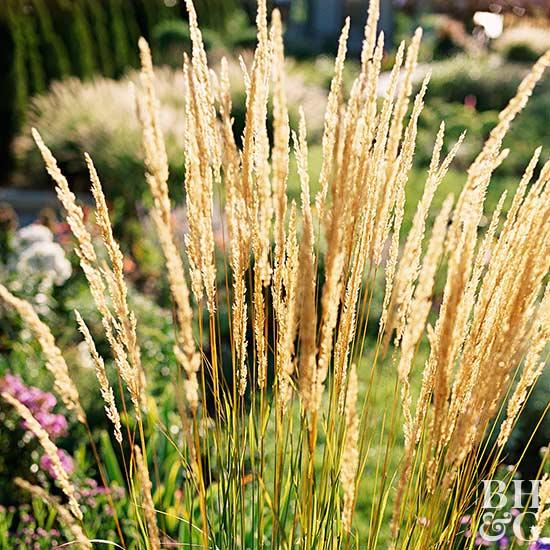

In landscaping terms we refer to the grass that requires mowing as lawns, while ornamental grasses are grasses with a pretty appearance that do not require weekly cutting back.
There is quite a variety of ornamental grasses available with so many different textures, sizes and colours to choose from.
Ornamental grasses have adapted over time and have become a good plant choice when considering a water wise garden.
The narrow, long leaf blades require less water to grow and their fibrous root system is well developed to survive drier periods.
Ornamental grasses can be grouped and mixed with other water wise plants to create a garden space that will require less watering with a reduced maintenance load.
Ornamental grasses come in a variety of interesting colours.
Acorus gramineus “gold” has extremely striking yellow foliage, grows to a height of about 25cm and is great to highlight a dull area of the garden.
Pennisetum clandestinum is a taller ornamental grass (approximately 1m high) with beautiful burgundy-red coloured leaves and amazing seed plumes.
Most ornamental grasses are green in colour and the different shades of green make different colour combinations very interesting to work with.
Contrast adds interest and excitement to a garden and prevents it from becoming too dull and boring. The different thicknesses of the individual leaf blades create different textures in the garden.
Most grasses create a fine, soft texture and can be used in contrast with coarser more robust elements in the garden. In a similar way colour can be used to add contrast.
There are even ornamental grass varieties with a dried, “dead” appearance that contrast well with other garden plants. These brown plants blend in well with other brown objects in the garden like pebbles, wooden barrels and bark chips.
The thin leaves of ornamental grasses move easily in a soft breeze. The movement of the leaves and seed plumes draws attention in what can otherwise be a very stagnant garden. The taller the ornamental grasses, the more movement of leaves can be expected.
Ornamental grasses do not shed their leaves as often as many other garden plants and it is there for advisable to stimulate new fresh leaves by cutting the plants back in early spring.
Ornamental grasses grow rapidly and the majority are tuft forming plants that grow from a central point and do not spread to adjacent areas of the garden – making them non-invasive. Ornamental grasses multiply abundantly and can be divided up in early spring to cover other sections of the garden.
Remember to always cut the transplanted plants back and only leaving about one third of the leaves’ original lengths. This will enable them to establish well by reducing the transporting shock and balancing the root mass with the leaf mass.
These low maintenance plants are very rewarding and can be used in a variety of different garden styles, depending on the actual chosen variety.
Whether they are used for erosion control, as a groundcover, as a means of creating interest in the garden, ornamental grasses are inexpensive and very easy to grow.
Article compiled by David Viljoen of Mercury Designs.