There’s nothing fishy about this extraordinary shell collection
Dan Spengler’s hobby of collecting shells all started in 1988, when he and his wife were on holiday at Chintsa, in the Eastern Cape.

“The first thing I used to load was my fishing rod and tackle,” said Spengler, who lives in Boksburg.
While on the rocks, fishing, the guy next to him suggested that if he wants to catch a mussel cracker fish, he must use the meat of a pink lady shell.
Spengler had never heard of a pink lady before. The next morning, he and his wife went off to go and look for a pink lady.

They succeeded in their search, and with that they also collected other pleasant-looking shells.
Spengler was interested in learning more about the shells he took home with him, so he started reading through a little book on shells of South Africa.
His interest developed and the next year they went back to collect more shells.
Spengler’s fishing downscaled completely and his shell-hunting officially began.
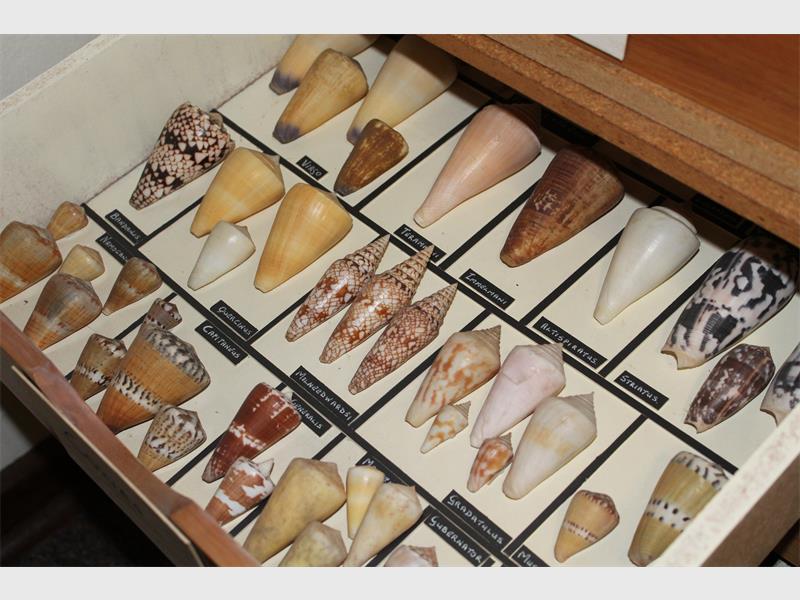
His shell collection consists of more than 3 000 species which he picked up himself, collected from fish gut, swapped and bought from other collectors or received as gifts.

He is a recognised shell collector and has had five shells named after him.
Spengler’s collection is well organised. Each shell has a number to a record card, with details on that specific shell (or specie) and the history thereof (where and how the shell was found).
All shells are organised in a glass cabinet and various filing cabinets.
On the shelves at home are numerous books on shells used for research.
According to Spengler, the most noticed and picked-up shells by the public are cones and cowries.
He explained it’s easy to identify the family to which a shell belongs
Then comes identifying the specie.

However, Spengler said it’s quite a process to name a new specie.
“At least four to five shells (one holotype and three paratypes) of a new specie must be used to describe the features of the specie. The holotype must be lodged in a museum and the paratype must be available on request for further study,” said Spengler.
“You must study the shells from worldwide to get a description of the new shell. The description of the new shell must then be published in a recognised scientific journal along with pictures.”
Spengler’s pride is the eight species he found, which were described by other shell collectors.
These shells are also used in the description of new species.
Spengler said the most difficult and unpopular shells to work with are those belonging to the Triphoridae family, because they are very small.
The smallest full-grown shell he has in his collection is 0.85mm.
Spengler describes his shell collection as a “fascinating hobby”.
It keeps him busy – he hasn’t been bored in his 17 years of retirement.
“You get to be out in the fresh air and get exercise,” said Spengler.
“It can also be very rewarding when other collectors recognise you as a collector and with shells having been named after you.”