Have you wondered how criminal’s think- Silke Kaiser has the answers
PROFESSIONAL polygraphist Silke Kaiser recently captured rapt attention at the East Rand Business Women meeting.
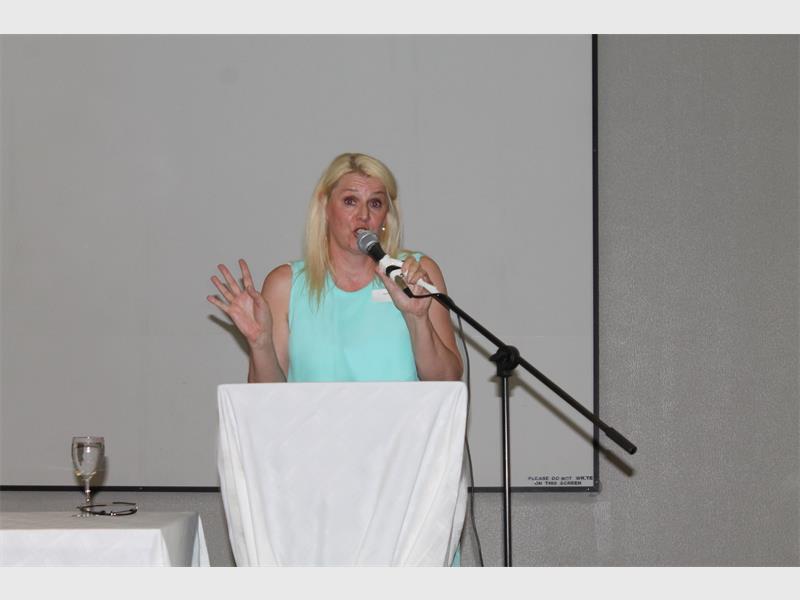

She fascinated the audience by weaving a tale of how criminals operate.
Kaiser has conducted polygraph tests for over a decade and has interviewed criminals such as housebreakers, car thieves, hijackers, farm attackers and drug addicts.
Currently studying towards a criminology degree, Kaiser has recently completed her first book titled: “Crime in South Africa”.
Relative poverty, lack of a strong father figure and porous borders are the causes of crime, according to Kaiser.

She said anyone who owns something, is vulnerable to become a victim of crime.
“Criminals are at high risk themselves, because they associate with other criminals and they steal from each other.
“People who are in possession of guns, money or jewellery are at high risk of becoming victims of crime, as those are the most prized possessions in a burglary or armed robbery.
“Companies place themselves at risk when a ‘high-risk’ employee joins the organisation. A person who gambles excessively, or takes any kind of drug, or has faked numerous sick days, or has stolen cash at a previous employer, is considered to be high risk.

“It goes without saying that anyone who has connections to a criminal syndicate is also a high risk employee.”
She said women are not likely to organise a burglary or an armed robbery at their place of employment. If they do so, it is most often at the behest of a man to whom they are ‘trauma bonded’ – most likely an intimate partner or a drug addicted son.
“The trauma bond is also known as the betrayal bond,” Kaiser said.
The polygraphist highlighted that witchcraft and crime in South Africa are linked. She said many people whom she has interviewed, told her that they visit traditional doctors to make them invincible when they commit crimes.
Kaiser said housebreakings are mostly carried out as an inside job, but those that are opportunistic mostly occur in the lower socio-economic areas.
That’s because dwellings in a higher socio-economic area have better alarm systems.

“Armed robberies are often inside jobs, so it’s always best to co-operate with your attacker. This is because you just have to assume the culprits already know everything that is in your house and that very possibly, they’ve already been in your house prior to the attack.
“Also assume that at least one of the guns is real; and that you will be shot.
“The trauma that victims therefore experience includes the fact that being shot or raped in such a situation, is a mere breath away. If victims remain calm, it is likely that the thugs will remain calm.
“It’s also best to have an emergency password shared with family members. If there’s a situation and the password is communicated, then at least help can be deployed quickly.
“If someone has a cellphone with battery power and only if it’s very safe to do so, the emergency number to dial for all service suppliers is 112. No airtime is required to dial this number,” Kaiser explained.
According to Kaiser, cash-in-transit heists are planned months in advance. She said either one or more employees at the company is approached; sometimes intimidation is used to ensure co-operation. Everyone who will be involved in the heist will most likely visit a traditional doctor.
“On the day of the heist, the members of the gang and the employee who is involved will all conduct a witchcraft ritual, as per the witch doctors instructions. Sometimes the muthi is thrown into the truck on the day of the heist.
“Often, if someone on the truck is shot dead, it is for two reasons – one is that dead men don’t speak and secondly, it’s one less person with whom the money must be shared.
“When it comes to a crime at a business, for example when a worker turns against the employer by stealing when they haven’t stolen before, then it’s often because of a wage issue. Either wages short paid, or an increase not given. It’s best to keep a very open dialogue with your worker and discuss any wage issues,” Kaiser added.
“Criminals have low empathy, no conscience and rules don’t apply to them. Whether criminals are sociopaths or not, they escalate in their crimes. Nobody who hijacks a vehicle, hasn’t committed a less serious offence in their past, Kaiser elaborated.
“We need to ensure that families stay together; parents must be taught life skills to enable them to parent their children correctly. Corruption in the government needs to be weeded out.
“Furthermore, the people entering our country through our borders need to be managed humanely. The police service needs a complete overhaul.
“For purposes of my book, I interviewed many police officers who confided in me that every single one of their colleagues, have taken bribes at some point. South Africa needs to adopt a zero tolerance policy to crime,” Kaiser concluded.