Give yourself a breast examination to figth cancer
Breast self-examination (BSE) is a procedure performed by an individual to physically and visually examine herself for any changes in the breasts and underarm areas of the body.

It has not shown that BSE alone can accurately determine the presence of breast cancer. Therefore, BSE should not be used in place of, but in addition to, clinical breast examination and mammography.
By doing BSE regularly, you get to know how your breasts normally feel, so that you are more apt to detect any change. Women should begin practicing breast self-examination by age 20 and continue the practice throughout their lives, even during pregnancy and after menopause.
A BSE should be performed every month.
Become familiar with how your breasts usually look and feel, so that you may notice any change from what is normal for you.
If you still menstruate, the best time to do BSE is several days, or about a week, after your period ends. These are the days when your breasts are least likely to be tender or swollen.
If you no longer menstruate, pick a certain day, such as the first day of each month, to remind yourself to do BSE. If you are taking hormones, talk with your physician about when to do BSE.
In the shower
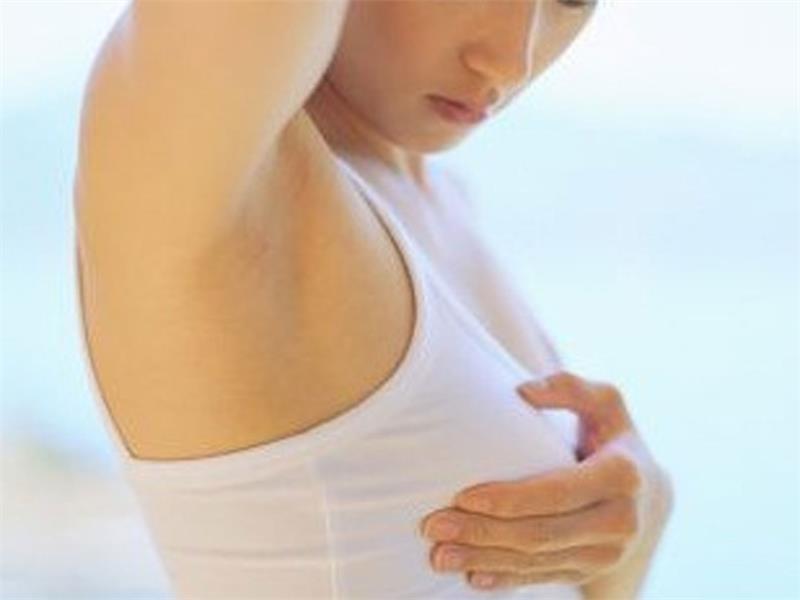
While taking a shower or bath, explore the breast and underarm areas with your fingertips. Raise one arm and place your hand at the back of your head. Slowly and methodically, move the pads of your fingertips over the breast in a circular pattern. Do not forget to feel the armpit area. Repeat on the other breast with your opposite hand.
In front of a mirror
Raise your arms above your head to check for changes in size, shape and contour of each breast. Look for puckering, dimpling or changes in skin texture. Gently squeeze both nipples and look for discharge.
Lying down
Lie down with you arm tucked behind your head. With the other hand and with your fingers flattened, feel the opposite breast.
Underarm area
Begin in the underarm area and move your fingers down until they are below the breast. Move your fingers in toward the centre and go slowly back up . Cover the whole area, going up and down.
With your arm resting on a firm surface, use the same motion to examine the underarm area. This is breast tissue, too.
q Information obtained from www.breastcancer.co.za